
Two Tools That Look Alike and Aren’t
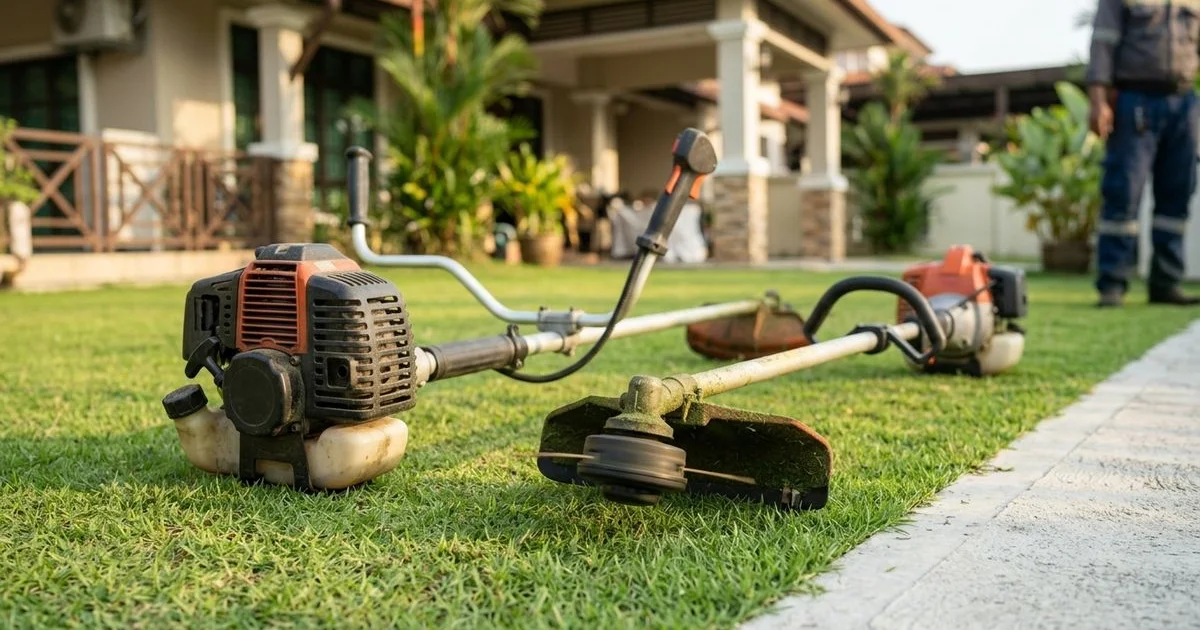
From a distance, a brush cutter and a string trimmer are the same machine: a shaft, a motor, a spinning head. The difference is what’s spinning and how much force is behind it, and that difference decides whether your lawn edges come out razor-sharp or chewed. It’s also why our edging and trimming service carries both on every visit.
The String Trimmer: The Fine Brush
A string trimmer spins a flexible nylon cutter line. The line slices soft green growth cleanly but yields against bark, fences and kerbs, which makes it the precision instrument:
- Bed lines and tree rings, where one wrong contact wounds a plant or trunk
- Path and driveway edges, where the goal is a fine, straight line
- Drain lips, working close to concrete without blade strikes
Its limit is density. Push a trimmer into thick, stalky overgrowth and the line wraps, snaps and tears instead of cutting, the result is the ragged, half-finished edge familiar from rushed jobs.
The Brush Cutter: The Heavy Blade
A brush cutter, the Honda-style workhorse on our crew, has a rigid shaft, more power, and can run metal blades as well as heavy line. It exists for everything the trimmer can’t push through:
- Fence lines and boundaries with thick, woody or long-neglected growth
- Overgrown lawns being brought down in stages during a rescue cut
- Rough strips beside drains and back lanes where grass has gone to stalk
Its limit is finesse. A brush cutter on a delicate bed line is a hammer doing scalpel work, it scalps, gouges and tears the very lines edging is supposed to sharpen.

Quick Reference
| Edge type | Right tool | Why |
|---|---|---|
| Flower beds, tree rings | String trimmer | Precision, no plant damage |
| Driveway and path lines | String trimmer | Finest straight line |
| Fence lines, thick growth | Brush cutter | Power through density |
| Overgrown rescue cuts | Brush cutter | Staged cutting capability |
| Drain edges | Either, by condition | Trimmer if maintained, cutter if overgrown |
Why scalping happens
Both tools cut at whatever angle the operator holds, there’s no deck setting the height like a mower. Wrong angle, wrong tool or a heavy hand digs the cut below the grass’s growing point, leaving the brown scalped stripes that take weeks to recover. Tool choice is half the fix; practiced hands are the other half.
What This Means for Your Garden
If you edge your own lawn with one machine, you’re compromising somewhere, usually with a trimmer being forced through fence-line growth it can’t handle, or a borrowed brush cutter roughing up the bed lines. A professional pass uses both, matched edge by edge, which is why the lines come out uniformly clean. (And why those lines are worth having at all is covered in why edging matters.)
On our visits, the tool swap takes seconds and the result lasts the fortnight. If your edges currently show tear marks, scalp stripes or straggler tufts, send a photo on WhatsApp, we’ll tell you what’s been going wrong and quote a visit to reset the lines.