
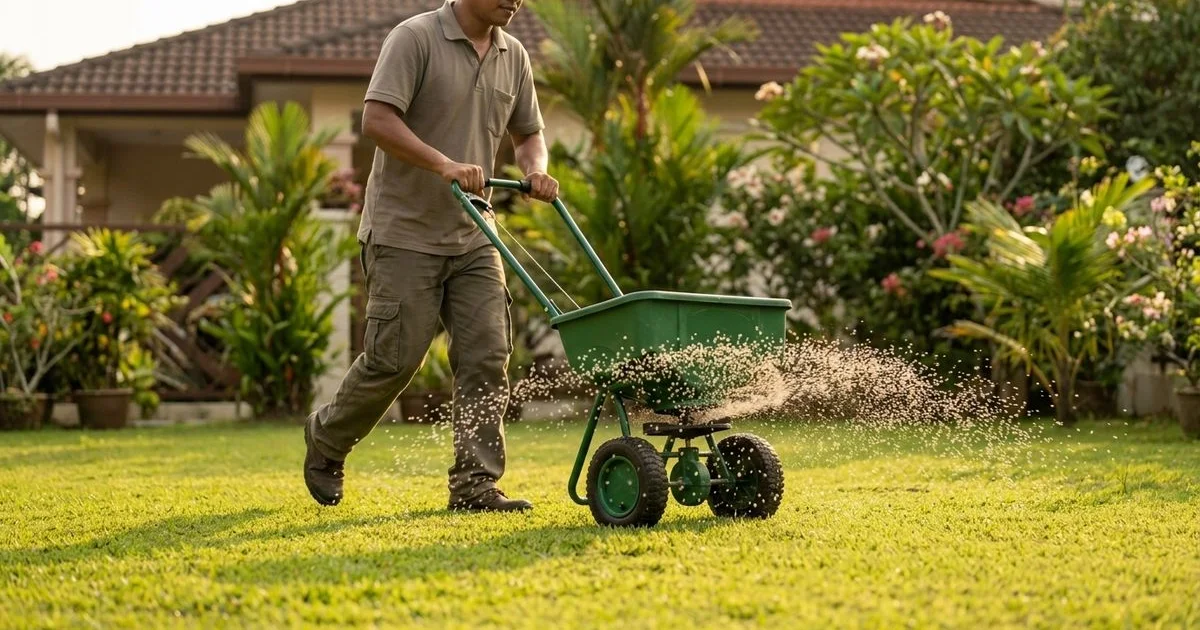
The Short Answer: Every 6-10 Weeks, Weighted to the Seasons
A Malaysian lawn does best on several feeds spread across the year, roughly every six to ten weeks for most lawns, with the schedule leaning into the growth seasons rather than spaced evenly. That’s the cadence behind our feeding programme for Petaling Jaya lawns, and the reasoning is all about how tropical grass actually grows.
Unlike temperate lawns with a single growing season, cow grass and carpet grass grow year-round, but not at one speed. Selangor’s two wet seasons (roughly March-May and September-November) are the growth peaks, and feeding should anticipate them.
A Year of Feeding, Season by Season
| Period | Lawn behaviour | Feeding approach |
|---|---|---|
| Jan-Feb (drier) | Slow growth | Light feed or rest |
| Mar-May (first monsoon) | Fast growth | Feed ahead of and into the season |
| Jun-Aug (inter-monsoon) | Moderate | Maintenance feed mid-period |
| Sep-Nov (second monsoon) | Fastest growth | Feed ahead of the season; support during |
| Dec (wettest, cooler) | Mixed | Hold off; rain leaches feed |
The principle running through that table: feed before growth, not during downpours. A feed applied two or three weeks ahead of a monsoon gives roots the nutrients just as the growth surge demands them. The same product applied in the middle of December’s daily storms washes into the drain.
Signs You’re Under-Feeding
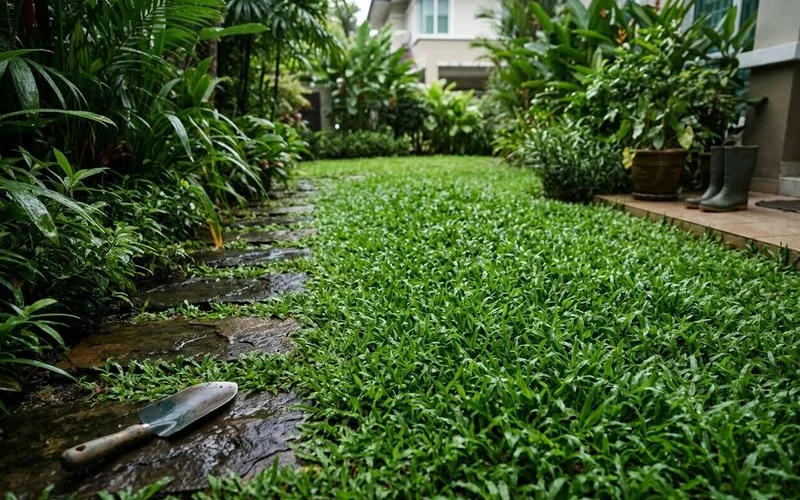
- Pale, yellow-green colour across the whole lawn, even after rain
- Slow recovery from mowing, foot traffic or pet damage
- Thinning density, soil visible between plants where the lawn used to be tight
- Weeds gaining ground, since a hungry lawn can’t compete with invaders
A chronically under-fed lawn doesn’t die; it fades. The colour dulls, the gaps widen, and one day the lawn that used to impress just looks tired.
Signs You’re Over-Feeding
- Scorched stripes or patches where product was over-applied, classic fertiliser burn
- Explosive, soft growth that needs cutting weekly and flops over
- Thatch building up faster than the lawn can break it down
Over-feeding is the more expensive mistake
Under-feeding wastes potential; over-feeding burns grass, builds thatch and feeds fungus. If in doubt, the lighter rate is always the safer one.
Why Feeding and Mowing Belong on One Schedule
Feeding makes grass grow; mowing manages that growth. Run them separately and they fight, a heavy feed before a missed cut produces exactly the overgrown, stressed lawn nobody wants. Run them together and each makes the other work better: we mow first so granules reach the soil, feed at a rate matched to the cutting cycle, and watch the response visit by visit.
That’s how the programme works in practice for our recurring clients: feeding slots into the existing mowing schedule, rates adjust with the seasons, and the homeowner’s involvement is precisely nothing. If you want to see what that looks like visit by visit, here’s what a feeding programme looks like across a season, or message us on WhatsApp and we’ll quote one for your lawn.